The Liberated Learning InstitutePartner with us
The Liberated Learning Model

The Liberated Learning Model.

Learning is not a ladder. It is a living process.

Let's liberate by naming the system.

We've assumed the problem is the child that cannot sit still or the teacher who is overwhelmed. We've passed blame onto parents being the problem, not engaged or responsive enough. To principals who cannot hold an entire building alone. When the room and structures are built against human development, we question and look at the system, not the people experiencing the harmful system. Our model begins here.
Pillar

Relational Ecology

We exist in an interconnected web of relations, human and non-human. A classroom is a web. A family is a web. A school community is a web. How we relate shapes what becomes possible inside the room.

Pillar

Embodied Learning

Our bodies and emotions are our greatest teachers. Our bodies need movement, rest, and play. Meeting our human needs is not a distraction from learning, it's the greatest learning opportunities.

Pillar

Restorative Culture

Conflict is curriculum. We center repair and do not punish. When harm happens, we address all those involved as human, centering truth, safety, and moving toward right relationship.

Pillar

Reciprocal Belonging

Belonging is inherent. We all belong because we exist. We examine bias, judgement, and lingering oppressive beliefs. No one needs to perform or earn respect, love, and belonging.

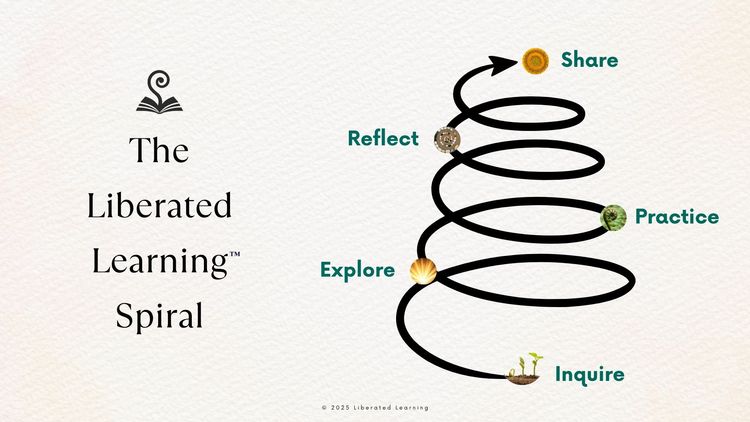
The Learning Spiral.

  1. Inquire
  2. Explore
  3. Practice
  4. Reflect
  5. Share

The ladder asks whether someone is on pace. The spiral asks what they are curious about now. This holds in a twenty-minute lesson, a six-week arc, and a full year. It returns to the same questions from new ground, with more capacity each time.

The learning spiral invites in the learner’s interests, culture, and purpose in a way that becomes education. Instead of forcing subjects onto learners, we follow their fascinations and discover how every passion naturally contains all the learning we need. One strong interest has the potential to be holistic, life-giving education. What a learner is drawn to is their curriculum calling. Learning spirals help us recognize and nurture the depth already present in their interests.

This reaches the orientation underneath learning itself — the pace, the questions, the shape of a room.

Curriculum that follows curiosity and skill together.

The model guides adult learning to stay steady when intensity arrives, classrooms that move from fear to participation families practicing learning as part of everyday life, and institutions building culture through relationship, not only rules.

Read Our Story

Read Our Story